Creating your own fitted sheet pattern opens up a world of possibilities for personalising your bedroom on a budget. Whether you're working with an unusually sized mattress, want to match your existing duvet sets perfectly, or simply fancy getting creative with fabrics, learning to make your own fitted sheets is a rewarding skill. Understanding what a fitted sheet is and its purpose forms the foundation for successful pattern making. Plus, there's something rather satisfying about tucking yourself into bed knowing you crafted those sheets yourself.
Why make your own fitted sheet pattern
Making your own fitted sheets might seem daunting at first, but the benefits quickly become clear. Custom sizing is perhaps the biggest advantage, especially if you've got a vintage bed frame, a caravan mattress, or one of those trendy deep-comfort mattresses that never quite fit standard shop-bought sheets.
Budget-conscious home makers will appreciate the cost savings too. Fabric shops often have brilliant remnants and sale items that cost significantly less than ready-made sheets. You can create luxury bedding for a fraction of the price.
Creative freedom with patterns and fabrics
When you're making your own sheets, you're not limited to what's currently trending in shops. Fancy floral bedding in a specific shade? You can find the perfect fabric. Want to coordinate with your favourite geometric cushions? Absolutely possible.
The trend of incorporating patterned fitted sheets into minimalist bedrooms has really taken off in 2026, making custom creation even more appealing.
Understanding fitted sheet pattern basics
A fitted sheet pattern consists of several key components that work together to create that perfect snug fit. At its heart, you've got a large rectangle (or square, depending on your mattress size) with corners cut out and sewn to create pockets.
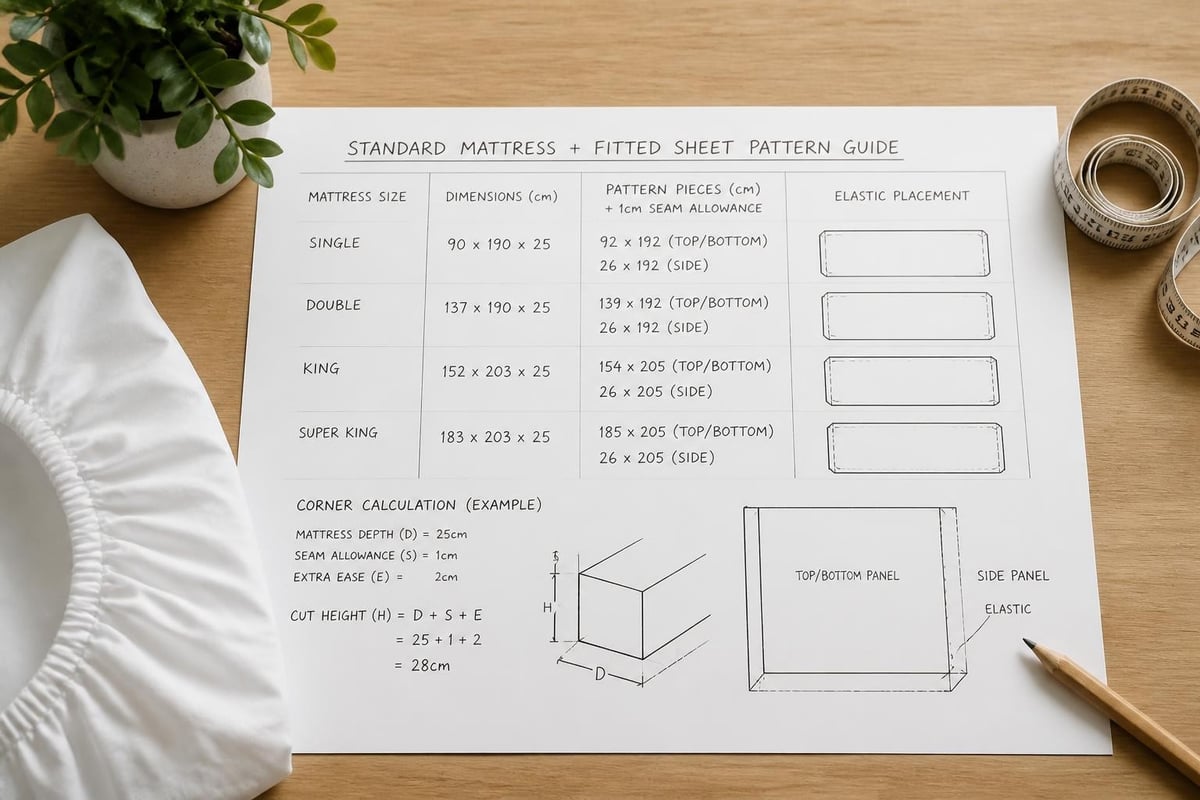
The essential measurements you'll need:
- Mattress length (top to bottom)
- Mattress width (side to side)
- Mattress depth (how thick it is)
- Seam allowance (typically 1.5cm on each side)
- Elastic casing (usually 1-2cm)
| Mattress Size | Width | Length | Typical Depth |
|---|---|---|---|
| Single | 90cm | 190cm | 20-30cm |
| Double | 135cm | 190cm | 20-30cm |
| King | 150cm | 200cm | 25-35cm |
| Super King | 180cm | 200cm | 25-40cm |
The corner pocket calculation
This is where many first-timers get confused, but it's actually quite straightforward. You need to cut a square from each corner of your fabric rectangle. The size of this square equals your mattress depth plus seam allowances.
For example, if your mattress is 25cm deep and you're using 1.5cm seam allowances, you'd cut out squares measuring 28cm × 28cm from each corner.
Choosing the right fabric for your fitted sheet pattern
Not all fabrics are created equal when it comes to fitted sheets. You want something that's comfortable against your skin, breathable, durable, and ideally easy to care for. Cotton remains the gold standard for most home sewers, offering excellent breathability and softness.
Jersey knit fabrics have become increasingly popular for DIY fitted sheets. They're stretchy, which means a more forgiving fit and fewer wrinkles. Plus, they don't require hemming on the edges, making construction simpler.
Pre-washing your fabric is absolutely essential. Sheets will be washed repeatedly, and you don't want shrinkage after you've done all that careful measuring and sewing. Wash and dry your fabric exactly as you plan to care for the finished sheets.
Fabric quantities you'll need
Generally speaking, you'll need fabric that measures your mattress length plus twice the depth, by your mattress width plus twice the depth, plus allowances for hems and seams. For a standard double mattress with 25cm depth, that's roughly 2.5 metres of fabric assuming standard width.
Buying a bit extra never hurts. You can use remnants for pillowcases or other coordinating bedroom accessories.
Step-by-step fitted sheet pattern creation
Creating your pattern starts with accurate measurements. Measure your mattress three times to be absolutely certain. Different areas of some mattresses can vary slightly, so check multiple spots.
- Calculate your fabric dimensions: Add mattress length + (2 × depth) + seam allowances
- Mark and cut corner squares: Measure depth + seam allowance, mark squares at each corner
- Remove corner squares: Cut out those marked squares carefully
- Pin corner seams: Bring cut edges together to form pockets
- Sew corner seams: Use a strong straight stitch with backstitching at ends
- Create elastic casing: Fold over the raw edge around the entire perimeter
- Insert elastic: Thread elastic through casing using a safety pin
- Secure elastic ends: Overlap and stitch firmly
The custom-sized fitted sheet tutorial provides excellent visual guidance if you're a visual learner.
Elastic options and placement
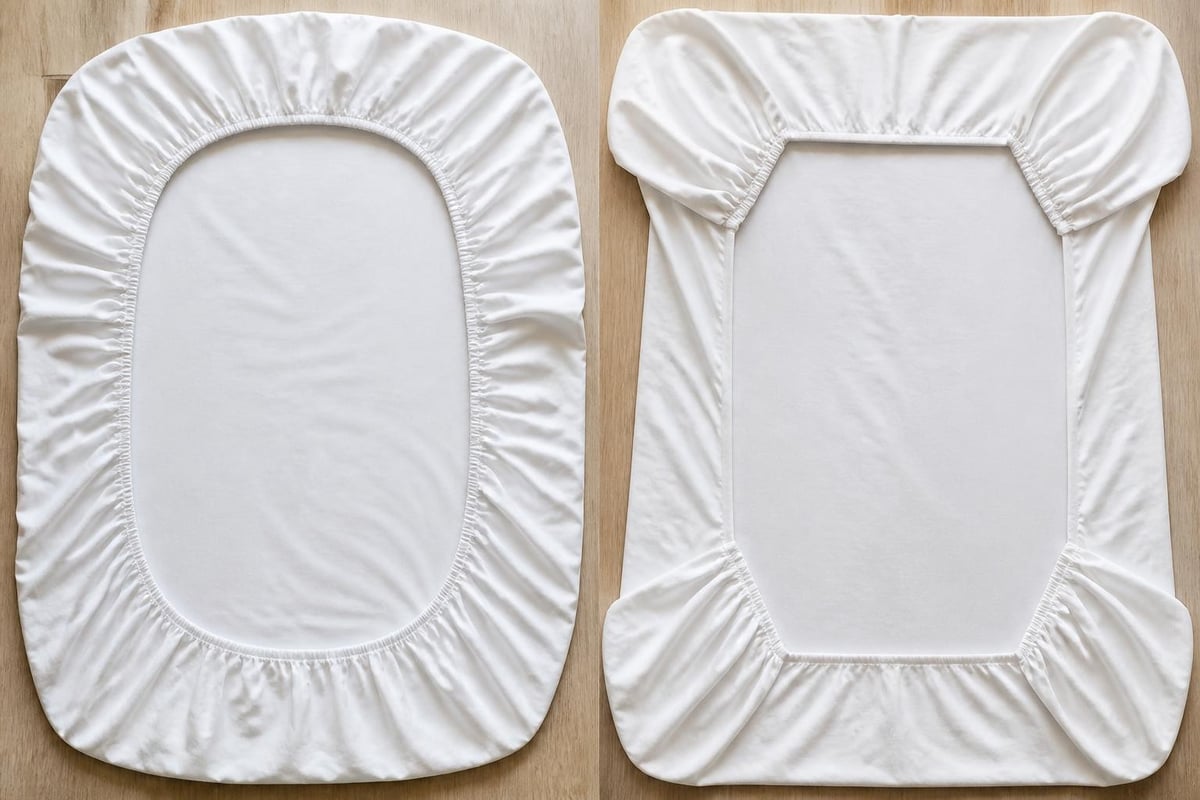
You have two main choices for elastic placement. All-around elastic provides the most secure fit but requires more elastic and can be trickier to sew evenly. Corner elastic (just at the four corners) uses less elastic and is easier for beginners, though the fit may not be quite as snug.
For corner-only elastic, measure approximately 25-30cm of elastic for each corner. For full perimeter, you'll need elastic measuring about three-quarters the perimeter of your mattress.
Common fitted sheet pattern mistakes to avoid
Even experienced sewers can trip up when making fitted sheets. The most frequent error is incorrect corner square sizing. Too small, and your sheet won't pull on. Too large, and you'll have baggy, awkward corners that bunch up underneath.
Another pitfall is insufficient seam allowance. Fitted sheets undergo considerable stress as you pull them onto the mattress, so skimping on seam allowance can lead to splitting. Stick with at least 1.5cm, and consider French seams for added durability.
| Common Mistake | Why It Happens | How to Fix It |
|---|---|---|
| Baggy corners | Corner squares too large | Recalculate using exact depth measurement |
| Sheet too tight | Corner squares too small or shrinkage | Pre-wash fabric, add 2-3cm to depth |
| Elastic too loose | Not enough elastic or stretched during sewing | Use three-quarter perimeter length |
| Puckered seams | Stretching fabric while sewing | Use walking foot and don't pull fabric |
Not pre-washing fabric deserves special mention because it's so easily forgotten in the excitement of starting a project. Cotton can shrink by 3-5% in the first wash, which on a king-size sheet could mean several centimetres of difference.
Testing your pattern before cutting good fabric
If you're nervous about ruining expensive fabric, create a test version using an old sheet or inexpensive muslin. This lets you check fit and adjust your pattern before committing to your lovely chosen fabric. It's an extra step, but one that can save both money and frustration.
Adapting patterns for special mattress types
Deep mattresses have become incredibly popular, with some reaching 40cm or more in depth. Standard fitted sheet patterns won't accommodate these, which is precisely why making your own becomes so valuable. The importance of proper fit with deep fitted sheets cannot be overstated when it comes to sleep quality.
For extra-deep mattresses, you'll want to add 5-10cm beyond the actual depth to ensure the sheet tucks properly underneath. This extra allowance prevents the fitted sheet from popping off during the night.
Mattress toppers and adjustments
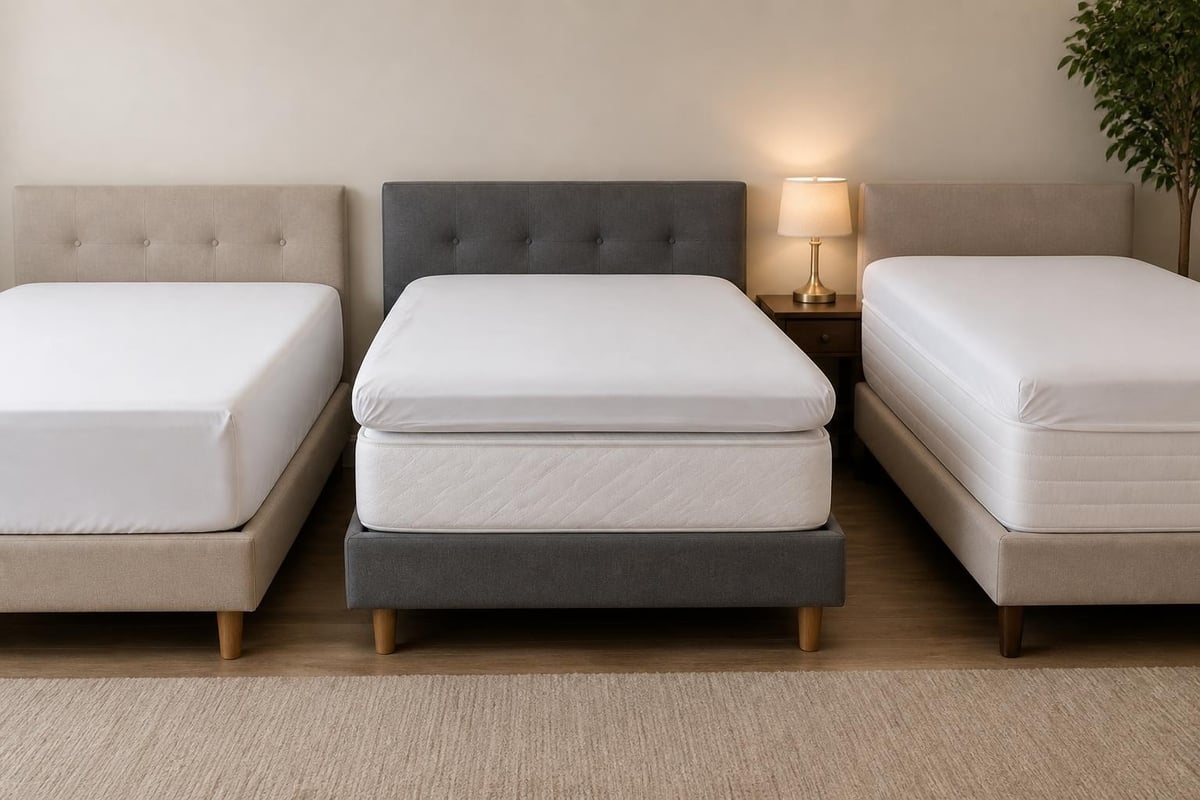
If you use a mattress topper, add its thickness to your mattress depth measurement. Better to have slightly baggy corners than a sheet that won't stay put. You can always tighten the elastic slightly if needed.
Design considerations for your fitted sheet pattern
While functionality comes first with fitted sheets, there's no reason they can't be beautiful too. When selecting fabric patterns, consider how they'll look once the sheet is on the bed. Large-scale prints can work wonderfully, but remember that much of the sheet will be hidden under the mattress.
Directional patterns require extra thought. Florals, stripes, or geometric designs that have an obvious "right way up" need careful layout during cutting. You want the pattern running lengthwise down the bed, which means positioning your pattern pieces accordingly on the fabric.
Coordinating your handmade fitted sheets with your existing bedding creates a pulled-together look. If you've got checks and stripes duvet cover sets, consider a complementary solid colour for your fitted sheet, or vice versa.
Colour psychology in the bedroom
Don't underestimate the impact of colour choice. Soft blues and greens promote relaxation, whilst warm neutrals create a cosy atmosphere. If you tend toward minimalist aesthetics, solid colours in natural fibres work beautifully, whilst those who love a bit of drama might enjoy bold patterns or rich jewel tones.
Caring for handmade fitted sheets
Once you've invested time in creating beautiful fitted sheets, proper care ensures they last for years. Always wash in accordance with your fabric's requirements, but generally, warm water (not hot) and a gentle cycle work best. Hot water can degrade elastic over time.
Tumble drying is convenient but can be harsh on handmade items. If you do tumble dry, use a low heat setting and remove sheets whilst slightly damp to reduce wrinkling. Line drying is gentler and more economical, though it takes longer.
Store fitted sheets properly by folding them neatly (yes, fitted sheets can be folded neatly with a bit of practice) or rolling them. Keeping sets together in labelled baskets or on shelving makes bed-making easier.
Extending the life of your fitted sheets
Rotating between multiple sets of sheets reduces wear on any single set. If you've made several using your fitted sheet pattern, alternate them regularly. This is particularly important if you're using bed sheets in high-traffic guest rooms.
Check elastic periodically. If it starts to lose stretch, you can replace it without remaking the entire sheet. Simply unpick a small section of the casing, thread new elastic through, and re-sew.
Budget-friendly fitted sheet pattern tips
Making your own fitted sheets should save money, not break the bank. Shop sales and remnants at fabric stores. Many shops have end-of-roll sales where you can snag quality fabrics at significant discounts. For a fitted sheet, you need a fairly large piece, but remnants are often large enough.
Repurpose flat sheets into fitted ones. Charity shops often have brand-new or barely used flat sheets for a few pounds. With your new pattern-making skills, you can transform them into perfectly sized fitted sheets. Understanding the differences between flat and fitted sheets helps you choose suitable candidates for conversion.
Online fabric retailers frequently offer better prices than high-street shops, particularly if you buy in bulk. Consider going in with friends on larger orders to save on postage and take advantage of quantity discounts.
Equipment you already own
You don't need fancy equipment to make fitted sheets. A basic sewing machine, scissors, pins, and measuring tape are sufficient. A walking foot attachment helps with even seams, but it's not essential. Many home sewers create beautiful sheets with just the basics.
Alternative approaches to fitted sheet patterns
Whilst traditional fitted sheets remain most popular, it's worth knowing about alternatives. Some people prefer using flat sheets with hospital corners for a hotel-crisp look. However, this approach requires daily bed-making and tucking, which isn't everyone's cup of tea.
Another option is creating hybrid sheets with fitted corners but a flat middle section. This combines the security of fitted corners with the ease of ironing flat fabric. It's particularly useful if you adore crisp, pressed sheets but find ironing full fitted sheets frustrating.
Split fitted sheets work brilliantly for adjustable beds or situations where partners prefer different mattress firmness levels. You create two separate fitted sheets that meet in the middle, each sized for its half of the bed.
Fitted sheet patterns for various bed sizes
Each bed size presents its own considerations when creating a fitted sheet pattern. Single beds are brilliant for beginners because they require less fabric and are more manageable during construction. They're also perfect for children's rooms, where you might want to create themed sets with character bedding fabrics.
King-size beds require more fabric and careful measuring. The larger dimensions mean more potential for error, so triple-check those measurements. The finished sheet is also heavier, making it slightly more challenging to manoeuvre through your sewing machine. If you're creating king bedding, remember that consistency in measurements across all pieces creates a professional look.
Super king sheets push the boundaries of what fits through standard sewing machines. You may need to work in sections or use a larger throat space machine. Consider the weight of the fabric too; heavier materials become quite unwieldy at this size.
Cot and unusual sizes
Fitted sheet patterns for cots follow the same principles but with extra safety considerations. Ensure elastic is securely stitched and there are no loose threads. Baby-safe fabrics and dyes are essential. Moses baskets, cribs, and caravan beds all benefit from custom-fitted sheets since standard sizes often don't exist for these.
Creating your own fitted sheet pattern empowers you to design bedding that perfectly suits your needs, style, and budget whilst developing practical sewing skills. Whether you're coordinating with existing décor, accommodating an unusual mattress size, or simply enjoying the satisfaction of handmade homeware, custom fitted sheets offer endless possibilities. When you're ready to complement your handmade creations with quality ready-made bedding, browse the beautiful selection at Happy Home Shop, where affordable, stylish homewares make creating your dream bedroom accessible to everyone.